
A LEAF IN THE WIND
WAYS OF TROPICAL BEING

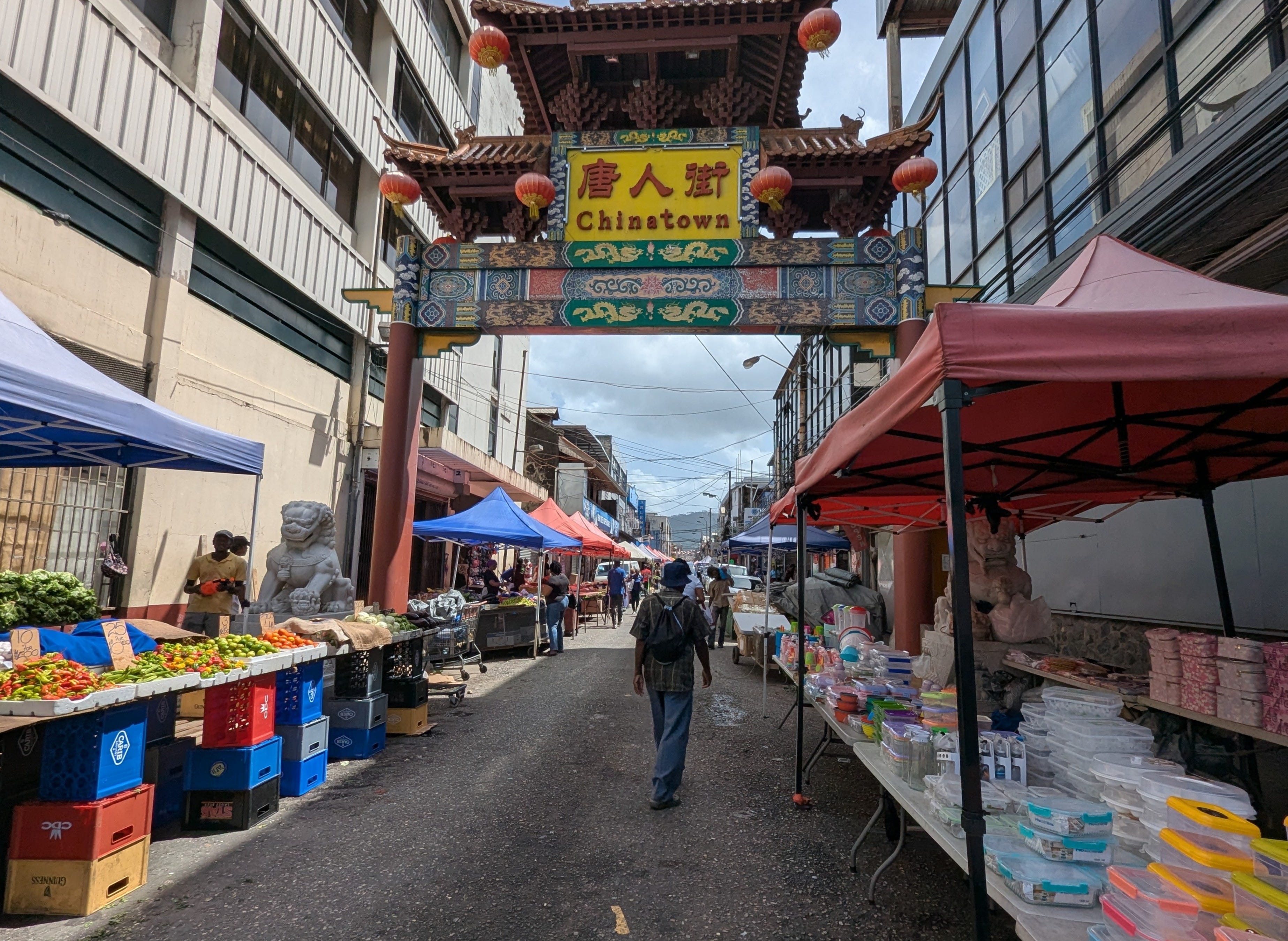
It was easy when I returned a few days later but the previous Friday Charlotte Street was the hurliest-burliest quarter of Port of Spain, like a living limb of an otherwise dying city. I was hunting spices for a dish I planned to prepare, or rather g/f wanted to prepare. I generally make do with whatever’s available at home, in the garden or the small grocery down the hill; not her, she’s finicky about ingredients; ours are different attitudes, mine, I like to think, drawing on my mother’s deep-seated tradition of expedient improvisation.
The dish was Chinese so we headed down Charlotte Street, which is where my maternal grandmother grew up when she arrived as a child about a hundred and thirty years before. As an adult she shopped in a grocery called Chung Hua until she was too old and feeble for the push and shove. A few years ago, to the chagrin of at least one calypsonian, the street was designated Chinatown.
Most of the pavement and half of the road on Friday was overtaken by vendors of vegetables and produce, leaving little room for pedestrians, far less cars, to squeeze through. Behind the vegetable stalls narrow, chaotic, dingy Chinese shops offered foodstuffs I’d never seen before and hadn’t a clue how they should be consumed. We couldn’t find one of the items we wanted, however. It was a Chinese chilli paste for which someone directed us to Wing Sing Ltd.
It was unlike any of the other Chinese establishments we visited, Hong Kong Super Plaza or Asia Resource Supermarket for instance. Blocking entry to Wing Sing’s shelves was a wooden counter and inches above it, bars and a glass screen, like in the small Chinese shops that dot the countryside. On the left was a metal grill door. To place an order I had to bend and shout through the six-inch gap between the counter and the screen. There were four people serving behind the counter, two young black women, a middle-aged black man and an elderly Chinese woman, plus the occasional customer.
A tall man with a scruffy beard came out from inside the shop shouting, I eh have nothing in my bag, you want to see? Look! Look!
He shook his knapsack upside down over the counter. A mess of personal items spilled out. The elderly Chinese lady was profusely apologetic. She had a stricken look and as she apologised she reached out and rested her hand on his forearm. It was a gesture of unusual tenderness and almost intimacy. I’m so sorry, she said, we didn’t mean to offend.
I got the impression one of the employees had offended him. He continued his complaints: I don’t thief - I coming here since I small! But his anger was subsiding as he repacked his knapsack. The Chinese lady continued mollifying him. I caught her eye and immediately seized the opportunity to ask if they had the paste we wanted. She said, Yes - come inside and get it.
Inside was different from the other such establishments that were characteristically chock-a-block with the widest possible range of items, especially mysterious foods, kitchen equipment, household goods and cheap plastic gewgaws alongside everything else you could imagine, computer keyboards, crayons, cellphone cases and lined notebooks. By contrast, although from outside the place seemed small, inside Wing Sing was dark and cavernous like a warehouse but with few wares on half-empty shelves. To my shock, there amongst the extremely sparse stock we immediately found a line of bottles of the chilli paste we sought.
The middle-aged, rotund black man standing at the cash register behind the counter took my money with a sceptical look and chuckled: You does cook Chinee food?
With a broad smile I replied: Ent I is a Chinee?
Actually, a browned, quarter-caste would never be considered a native anywhere in the celestial kingdom, but this is Trinidad and, as I grow older and my now-grey hair grows straighter, especially when shorn, people increasingly consider me to be of oriental inclination. As the ancient proverb goes, the leaf returns to the roots. Since almost everything I prepare in the kitchen - be it hamburgers or oxtail stew, curry chicken or roast pork - contains soy sauce, oyster sauce, five-spice seasoning and, when g/f not here, vetsin powder, it wasn’t far-fetched to respond with:
If I is a Chinee, then whatever I cook hadda be Chinee food.
We laughed but the point was serious because, as a journalist, I was once accused of being racist for writing critically about Indian music without being Indian; and it was similarly argued I couldn’t review calypsoes, which were seen as an African art form whereas I was not a “real” African. I’ve almost been cancelled - would have been but for some quick damage control - for bemoaning the conservatism of the steelband movement without being in a steelband myself. Similarly, some said I ought not have been chosen to head the Carnival Institute because I wasn’t genetically suited.
In an interview I was once asked how I defined myself, or was it irrelevant, an accident of birth?
I considered it a fortunate accident that I am many ethnicities: European, African, Asian and Creole. I demand all partly because my biological DNA includes Sub-Saharan, European and Chinese strains, but more importantly because my cultural DNA has that plus. I contain multitudes.
What did I mean by “cultural DNA”? my interlocutor enquired.
I’m part of the New World civilization, which includes North and South America and the islands in between. Based unfortunately on the genocide of the original people, all of us are immigrants, White people, Black people, Indian people, all came from somewhere else, and we created what in a sense is the modern world whose culture, whatever your biological background is, partakes of Europe, Africa, Asia and the indigenous Americans.
You could be the most racist redneck, yet you are still partly African because of the way you walk and talk, the music you like, all of which came partly out of the Black experience - that is, Black culture.
On the other hand, some years ago a friend of mine from Benin who lives in Trinidad had his father visit from his rural village. Afterwards I asked my friend what his father thought of Trinidad. He said his father enjoyed it, that he was amazed at how rich it was, and how many White people were here.
I asked in surprise: Where you take him to see all these white people? Nowhere special, he said: around Port-of-Spain he only saw White people.
And now I really didn’t understand. I asked him to explain.
To his father a man’s tribe was determined by the language he spoke, the culture he practiced, his religion, clothing, gender roles, his public demeanour. All that determined your tribe, whether you’re genetically African, Indian, Chinese. If you dressed and spoke and thought in a certain way, then, as far as his father was concerned, you were a white man.
What language do we speak? We wear jeans and t-shirts, our states follow a European-type democracy, we study in European institutions. So as far as his father was concerned, we were all white people.
It made sense. Your tribe is a cultural construct. In which case, I claim all. When I speak about the African contribution to the world, I say it’s ours... I remember it when Burning Spear asks, “Do You Remember the Days of Slavery?” I answer: Yes I do, because my brother was there. He passed through that holocaust. At the same time I honour our Chinese ancestors: both of my daughters’ middle names are Chinese as a homage to that. And I am wedded to the English language that I love.
My exchange with the Wing Sing cashier about my culinary skills hopefully forestalls an analogous query that’s already raised its head: how can accounts of bookshops in London and Cambridge, such as I’ve written for this blog, and meditations on New York’s Met and London’s Kew, Picasso’s Guernica and Minerva’s owl, be considered ways of tropical being?
I was born and bred on my small, Caribbean island, studied briefly in Jamaica and Barbados, and have never lived elsewhere. My DNA is tropical, even if the leaf’s fall to its roots is indirect, just blown in the wind. Accordingly, my life’s experiences, including my close encounters with colder climes, will remain as they ever were, ways of tropical being.
Wonderful Dr. Kim,
I will have to visit "Wing Sing Ltd." to, not only purchase some of those ...ingredients... but to check out those reasonable 'nik-naks'...
Thanks for Sharing...
Thanks for that, Kim. You did not meet Mr Wong in Wing Sing then, only the tall Chinese lady.
Mr Wong always said he and I were family, since I was a Wong Chong.
Here's my Charlotte Street: https://wildgirlwildworld.blogspot.com/2017/05/charlotte-street.html
And celebrating Anjani's daughter, my grand-daughter born last month: https://wildgirlwilrworld.blogspot.com/2026/05/arrival.html