
A SEA - WITH A STEM
WAYS OF TROPICAL BEING

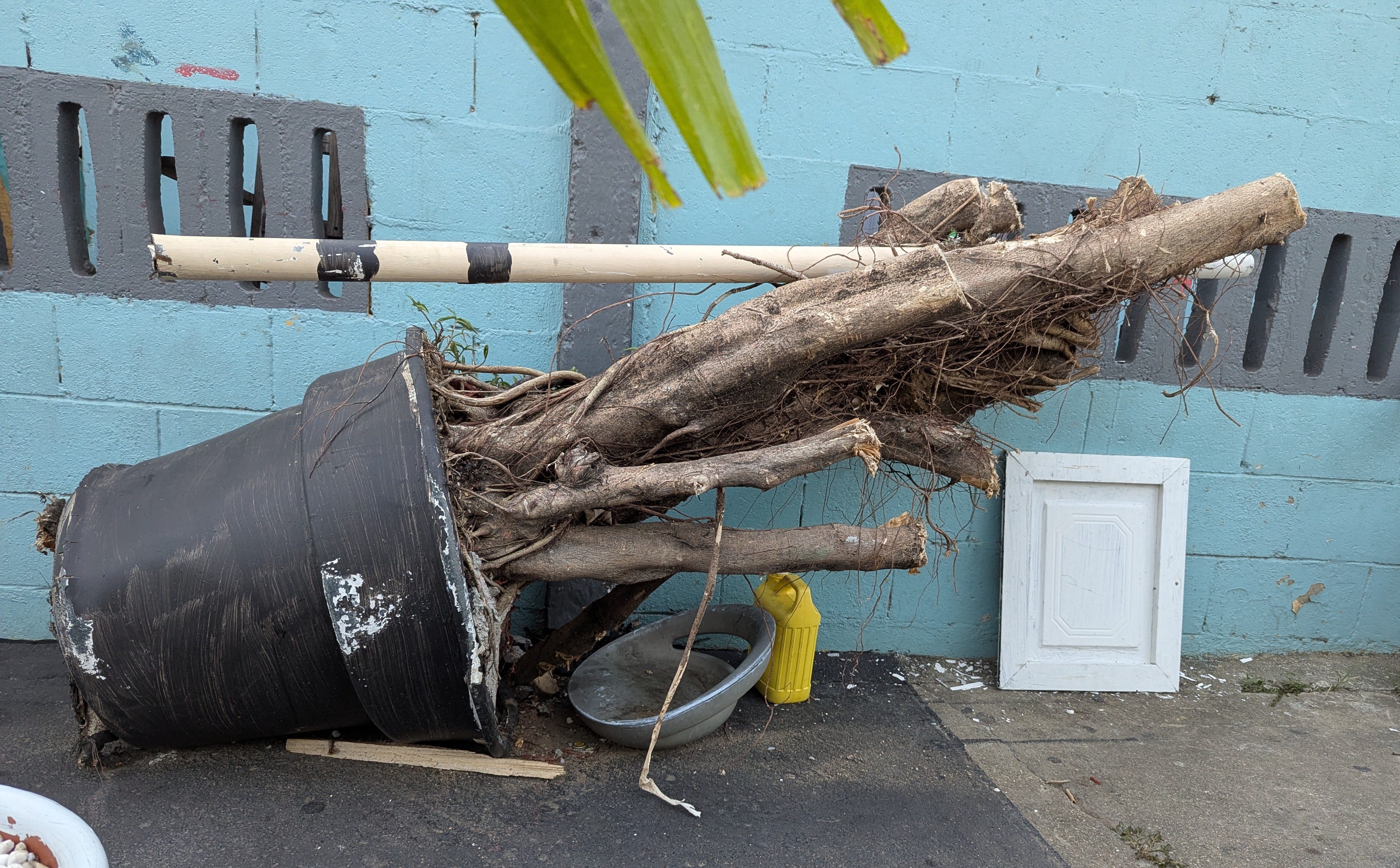
Allyuh chop the tree dong?
I inquired in disbelief and deep sadness upon seeing the twisted remains of its severed limbs. Even its necrotic pot, supine, appeared to have shrunk.
Propped casually against the wall a few feet from what seemed the scene of a senseless crime, the young man was nonchalant: Nah - it fall dong from the weight.
Fall dong or wind blow it dong?
The wind blow and it fall dong.
It is indeed our breezy kite-flying season. I turned away to resume my constitutional down Ethel Street, muttering over my shoulder slightly embarrassed by the sentiment: I almost feel like I lose a ole fren.
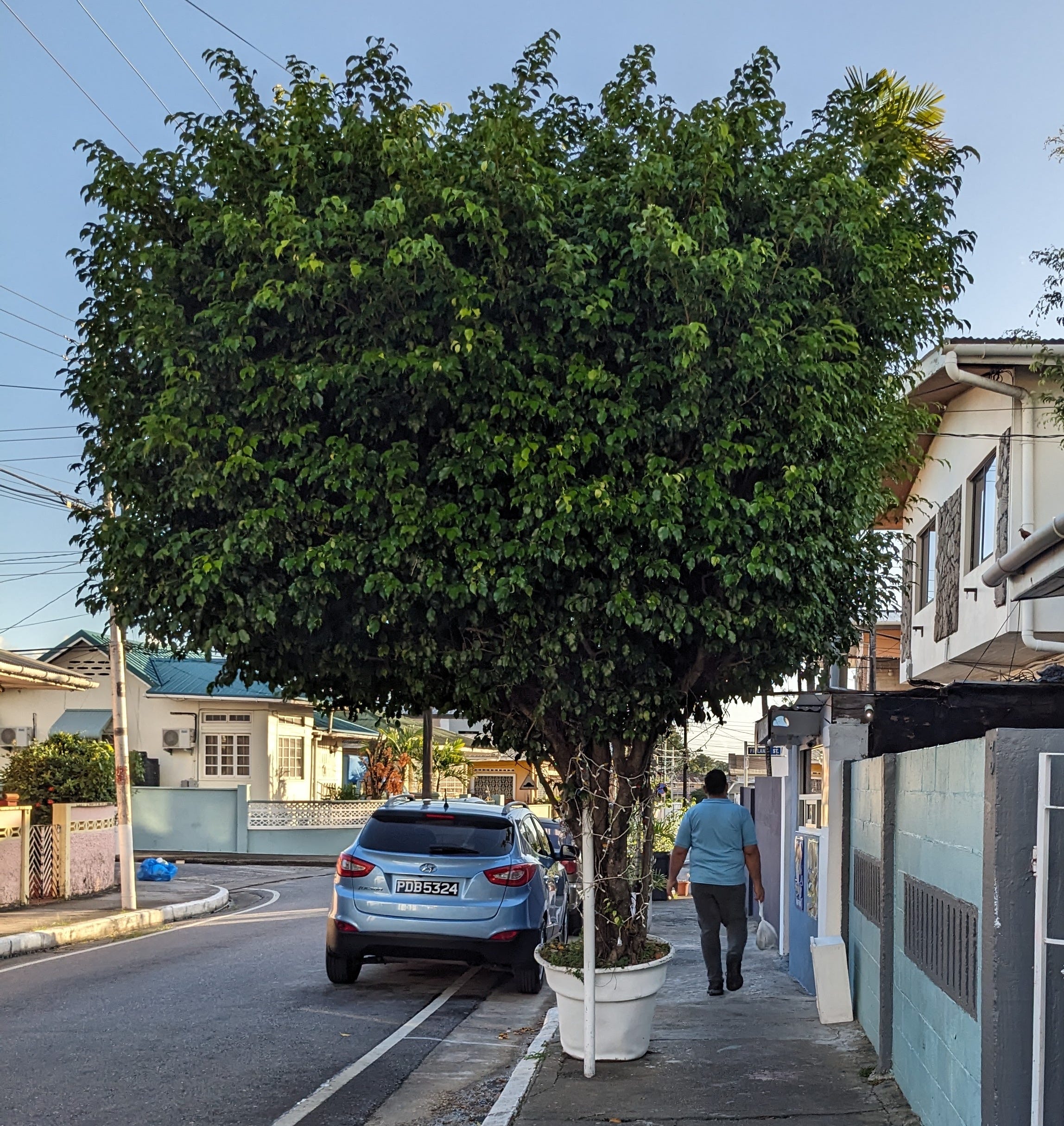
Pushing on through St. James into Woodbrook I contemplated my sense of personal loss. I realized I wasn’t so much the tree’s friend as an admirer. Every time I walked by I marvelled at how it flexed fifteen feet from what was but a thimble when compared to its vast, thick, abundant greenery. Below, it must have pierced the plastic pot that constrained it, boring through the concrete pavement below, down into the earth. I was awestruck by its implacable determination to be bounded by a nutshell and still count itself a king of all infinite space.
“A Sea” is how Emily Dickinson described such luxuriance, “with a Stem”.
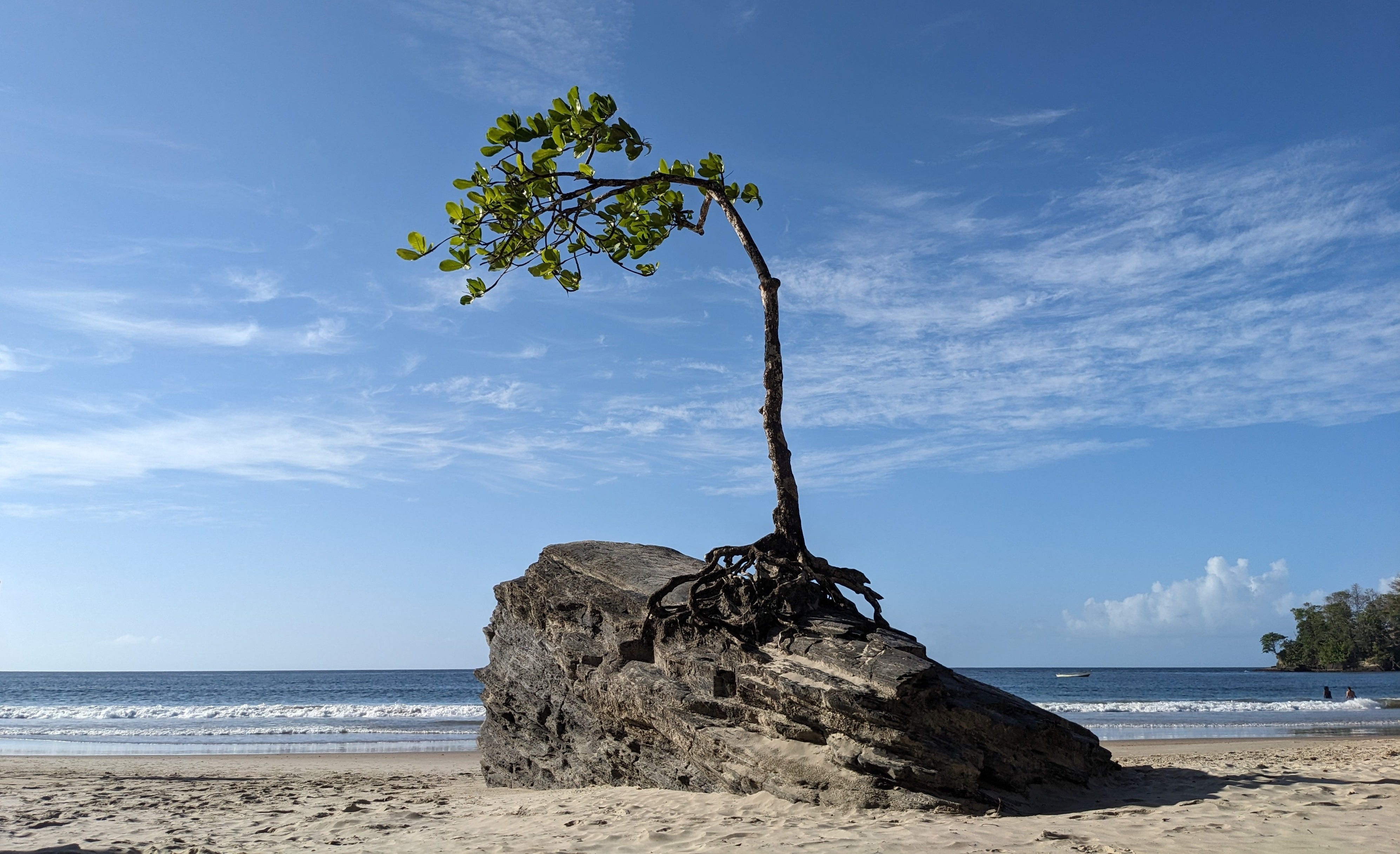
I was reminded of another tree I admire and cherish for similar reasons, as I’m sure does everyone else who sees it perched atop its rock on Las Cuevas beach. Its rugged, gnarled roots grip tightly to a tiny, barren promontory surrounded by dry, off-white sand. Such tenacity! From what does it draw nourishment? I can’t help but imagine it clambering off its plinth late at night like a terrified triffid in search of soil.
It’s not that I’m some kind of fanatic tree-hugger. The hardiest shrub entrusted to my care struggles to survive. And although I hold forests in great regard for having travelled the entire journey of evolution beside us, lungs of the planet and all that, I’m not talking about those vast conglomerations of anonymous bush and beasts. Instead I focussed on individual flora that my personal experience had set apart from the faceless crowd. The Ethel Street tree had summoned them to mind one after the other, starting with the oldest: a mango tree that over sixty years ago, once or twice annually, brought blessed relief to three vomitous children, of whom I was one, by indicating that an eternity’s drive to Toco in the backseat of a Vauxhall Victor was nearly done.
Today that tall and proud mango tree still stands on its hairpin bend beside an ancient, dry standpipe. It still informs me that Toco is only five minutes away, and although the drive doesn't bother me now I feel a deep fondness and gratitude for the heads-up from one survivor to another, even if it also upsets me to see its condition, which is even more bedraggled than I am.
This being a land of mango trees there are several others I recall, especially one in Point Cumana where I lived at the turn of the century. I can’t recall it actually bearing a mango but it did possess low, spreading branches on which I attempted to construct a treehouse. I got no further than nailing a plank between two branches to create a lop-sided aerial bench on which I tried (unsuccessfully) to read a book in honour of my friend and literary sidekick, Keith Radhay, who’d recently died.
Many years before, in the mid-eighties, Keith, on my encouragement, entered a local literary competition that he won with “The Reader in the Tree”. It was a charming tale (much better than my effort) about someone in his rural hometown of Ecclesville who habitually reclined in a particular tree consuming books, to the bemusement, suspicion and eventual hostility of other villagers.
Keith and I those days were both enamoured with Italo Calvino’s novels and if I leaned into The Nonexistent Knight, Keith was inclined to The Baron In The Trees and although I didn’t appreciate it at the time, he had brilliantly combined Calvino’s philosophic novel about an independent, arboreal-dwelling noble with his personal, down-to-earth experience of growing up a bookworm in a semi-illiterate community. Keith’s reader read pulp fiction, nothing profound or literary, just cowboy and sci-fi novels, fantasising amidst the foliage simply because it was the only place he wouldn’t be disturbed.
He sought peace and privacy on a high branch because, despite the peril of gravity, being up in a tree provides a sense of safety, a distance from danger, even a kind of invisibility, which are the most fundamental forms of privacy. It’s an enduring fantasy that anyone caught in hostile terrain can find safety once there's a tree available.
That sense of safety no doubt came from our early days four to six million years ago and the loss we experienced having left the trees to roam the scary East African savannahs. Fortunately, our previous home above the ground yet not quite in the clouds also equipped us with our acute 3D vision and its rich colour palette, our firm (thumb-opposed) grasp, and our coordination of the two. And they shunted us on to the road of intelligence (alongside the rest of our simian cousins). So we have a lot to thank our arboreal home for. That’s why in universal mythology the axis mundi, considered the place of creation, is often a unique tree that joins the underworld to the heavens (like Eshu).
Such sacred trees grew in most religions. Yggdrasil, for instance, an evergreen ash, was the centre of the Norse universe. It held up the sky and extended over heaven and earth. Its canopy was Asgard, realm of the gods. Its trunk and high branches supported Midgard, realm of humans. Its roots included the realm of dwarves, giants, fire and the dead.
Buddha gained spiritual enlightenment under a (Bodhi) tree as, in an equally important sense, did Eve. And from a well-known but now-deceased silk cotton tree in Culloden, Tobago, an enslaved woman who Whites dismissed as a “witch” but was actually a nganga or spiritual healer of the Kongo tribe, Gang Gang Sarah, attempted to fly home to Africa. Maybe she didn’t know that silk cotton trees (also known as the Ceiba or Kapok) are Caribbean gateways between the living and the dead, because she fell to her death. They are inhabited in Trinidad by jumbies trapped through the trickery of Papa Bois, the father of the forest. That’s why every silk cotton tree is feared by those in the know but also the source of immense power.
I could go on but you get the idea, so now allow me to ask: are there any particular trees to which you have felt personally attached? After all, we didn’t just co-evolve alongside them: they have been our haven, fed and provided us with medicine and indeed Adam and Eve’s first articles of clothing, and we worshipped particular ones in return. So give it a thought - it will make you more mindful. Maybe it’s an ancient Samaan in a nearby savannah, an Ent supporting so many bromeliads - orchids, ferns, mosses, lichens and Spanish moss - it’s more an eco-universe than an individual organism. Maybe it’s some mango tree you scaled illicitly like a child of the universe, or from which you swung as free as your early ancestors. Alongside the driveway of what was in 1988 my family’s Toco beach house leaned a coconut palm that (decades after the house was disintegrated and the tree dead) in 2022 healed my broken heart. So in tribute to whatever trees may have endeared themselves to your heart, allow me to present to you my Ethel Street rebel, not half-past dead as last week, but in all its glory, when it was defiantly, explosively alive:
There is hope; unlike a lover's sustained neglect, such a tree as your Ethel Street rebel could live again. Take it home, repot it with some good compost, nurture it and it may return to life and flourish.
At my house, dominating the garden, stands a huge, tulip tree. I cannot imagine the house without imagining the tree. In a garden in Kent, there’s a beech tree, where my childrens’ grandparents’ ashes were scattered. I cannot bring the house to mind without the tree. In England, where I lived for many years, there was a field with an ancient oak tree where we would picnic under its branches. I cannot recall that landscape without visualizing the tree.
And yes, trees can be wonderful metaphors. Whilst living at the hospital with my partner during the final days of his life, I reminisced how he, like those trees, was as necessary to me; how he was a reminder of how my own landscape had been enriched by him. In honor of him, I read this poem by Maya Angelou at his memorial.
When great trees fall
rocks on distant hills shudder,
lions hunker down
in tall grasses,
and even elephants
lumber after safety.
When great trees fall
in forests,
small things recoil into silence,
their senses eroded beyond fear.
When great souls die,
the air around us becomes
light, rare, sterile.
We breathe, briefly.
Our eyes, briefly,
see with
a hurtful clarity.
Our memory, suddenly sharpened,
examines,
gnaws on kind words unsaid,
promised walks never taken.
Great souls die and
our reality, bound to
them, takes leave of us.
Our souls,
dependent upon their
nurture,
now shrink, wizened.
Our minds, formed
and informed by their
radiance, fall away.
We are not so much maddened
as reduced to the unutterable ignorance of
dark, cold
caves.
And when great souls die,
after a period peace blooms,
slowly and always
irregularly. Spaces fill
with a kind of
soothing electric vibration.
Our senses, restored, never
to be the same, whisper to us.
They existed. They existed.
We can be. Be and be better. For they existed.
Awesome... The things that we take for granted... - I too can recall the various trees which grew around our home, in particular a 'Paddoux' tree - when I first climbed it in the early '70's.. it was on that main branch, which, now, thinking of it I can describe it as a 'ledge' and on that ledge, embedded within it was a metal-box that I had easily surmised, even back then, had been placed over the area where said tree was planted many moons ago to protect it from either fauna [mainly dogs] or from the traipsing of the human species... that metal box was of the kind that covered the stop-cork for the water supply to houses and was way before it's time in Waterhole, Cocorite... for it would be 9 years or so before a stand pipe appeared on the hill - it gave water for a short period before the pipe disappeared entirely!
I still visited the Paddox tree just to see that embedded metal box or was it to pick of its delicious fruit which was coated in a brown-fur covering?
[PS: I tried to google a photo of said fruit with no luck...
Gracias for allowing my simple comment....